RewardVerse: Rubric-Guided Policy
Optimization for Video Reward Modeling

A dynamic rubric placed between the evaluation query and the scorer mitigates scalar drift in video reward models β€” with state-of-the-art pointwise correlation and pairwise preference agreement from only 30 preference pairs per dimension.

Zhenchen Tang1,2,4 Yang Li1,2,4 Songlin Yang3,4,† Bo Peng1,2 Xiaotong Zhao4 Shuai Li4 Haotian Fan4 Alan Zhao4 Jing Dong1,2,*
1New Laboratory of Pattern Recognition, Institute of Automation, Chinese Academy of Sciences 2School of Artificial Intelligence, University of Chinese Academy of Sciences 3The Hong Kong University of Science and Technology 4Tencent
Overview

Score the criteria, not just the video

Professional annotators rarely assign a score in one shot: they first decompose the task into explicit criteria, then judge against them. Video reward models largely skip that criterion-setting stage, so their internal scoring standard drifts with every prompt. RewardVerse restores it by making the rubric a learned intermediate representation.

TL;DR

RewardVerse first generates a query-adaptive rubric (themes, weights, tips) from the evaluation query alone β€” the generator never sees the candidate video β€” and then scores each theme with a soft-logits readout over the rating tokens 1–5, aggregating them by their weights into a continuous pointwise reward.

Rubric-Guided Policy Optimization (RGPO) trains this pipeline in two GRPO stages: a seed-rubric scorer warm-up followed by joint optimization of the rubric generator, with a human-aligned margin calibration loss throughout. The result is a reward that keeps its scale, stays stable under prompt paraphrasing and input reordering, and transfers to pairwise preference benchmarks beyond its training dimensions.
+82.6%
score-range expansion (Οƒ 0.258 β†’ 0.471) from rubric + soft-logits
30 pairs / dim
480 preference pairs in total β€” no supervised fine-tuning
14/16
EvalVerse dimensions with the best PLCC, macro-avg 0.554
0.164 vs +0.610
prediction bias after RGPO under the same dynamic-rubric protocol
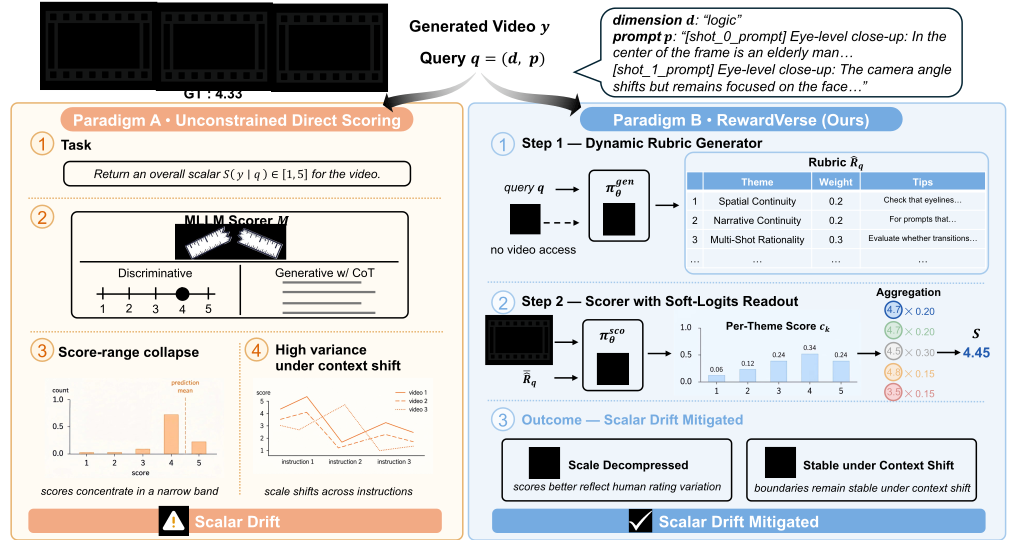
Unconstrained direct scoring vs. RewardVerse rubric-guided scoring
Two evaluation paradigms. Unconstrained direct scoring (left) collapses into a narrow high-score band and shifts with the instruction phrasing. RewardVerse (right) generates a rubric from the query, scores each theme through soft logits, and aggregates by weight β€” producing both a decompressed scale and a stable score under context shift.
The Problem

Scalar drift in video evaluation

Directly mapping a subjective, multi-dimensional video to one scalar is an unconstrained task: the model has no explicit anchor for what each point on the 1–5 scale should mean. The scoring standard then drifts in two interacting ways.

1 Β· Score-range collapse

Pointwise scores concentrate in a narrow β€œsafe” high band. The gap between preferred and non-preferred videos shrinks, leaving downstream RL with near-flat gradients.

2 Β· High variance under context shift

Without anchors, the scale moves when instructions are paraphrased or candidate order is swapped, so the same content receives inconsistent scores or preferences.

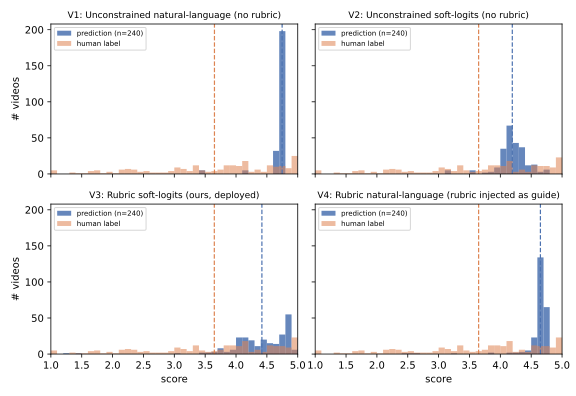
Pointwise score distributions of four scoring variants
Four-variant study on the same 240-video hold-out (Qwen2.5-VL-7B). Rubrics decompress the scale only when paired with a continuous readout: adding the rubric under soft-logits (V2 β†’ V3) widens Οƒ by 82.6%, whereas natural-language floats (V4) remain anchored to the model's high-band linguistic prior β€” two-thirds of the pairs still tie. Blue bars are predictions, orange bars are human labels.
Method

Rubric-Guided Policy Optimization

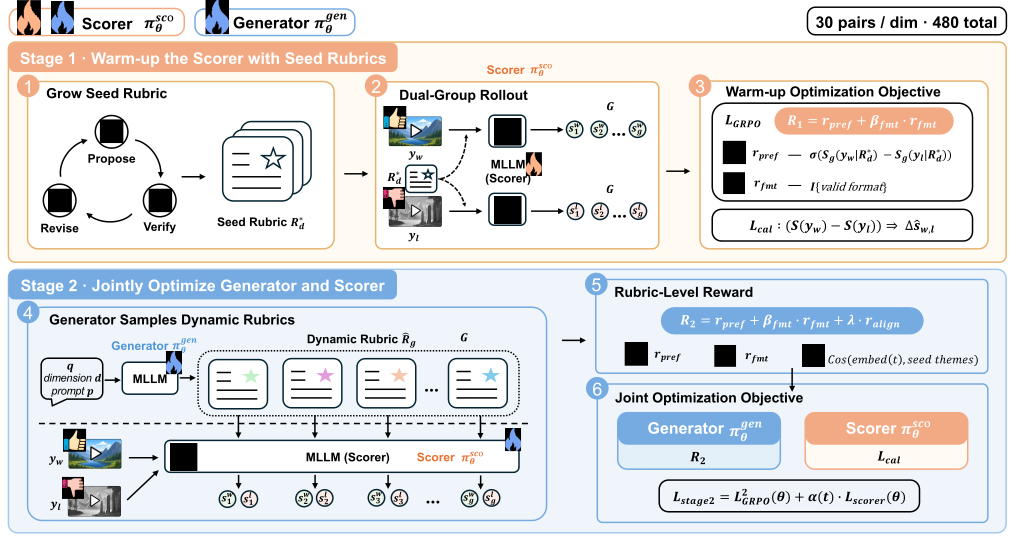
One shared MLLM plays two roles β€” a rubric generator and a scorer β€” distinguished by role-specific prompts. Stage 1 builds a human-aligned scorer with frozen seed rubrics; Stage 2 lets the generator adapt per query while the scorer stays calibrated.

RewardVerse pipeline and two-stage RGPO training overview
Dynamic rubric generation from the query (never the video), soft-logits per-theme scoring, weighted aggregation, and the two RGPO stages with preference, format, alignment and margin-calibration signals.
Stage 1 Β· Seed-guided warm-up

Build a calibrated scorer first

  • Self-evolving seed rubrics: a frontier MLLM proposes β†’ verifies β†’ revises rubrics over 30 preference pairs per dimension; verified ones are deduplicated (Jaccard + MCRΒ²) into 5 representatives.
  • GRPO on the scorer role: a sigmoid preference reward over the scored pair plus a binary format reward, with group-standardized advantages.
  • Human-aligned margin calibration: the predicted score gap is matched to the human gap, so the reward scale itself stays meaningful.
Stage 2 Β· Joint policy optimization

Adapt the rubric, keep the scorer honest

  • Rubric-level GRPO: each sampled rubric is rewarded by how well it separates the preferred from the non-preferred video, plus format validity and BGE-M3 alignment with seed themes.
  • Asymmetric signals: the generator gets the policy-gradient update; the scorer receives no gradient from that reward and is optimized only by margin calibration against the sampled rubrics.
  • Why: otherwise the scorer could inflate reward simply by enlarging score gaps, without becoming better calibrated.

Query-only rubrics

The generator never sees the candidate video, which prevents biased, video-dependent criteria. Rubrics are reused across videos with the same query β€” the marginal cost per video is small.

Soft-logits readout

Instead of parsing digits from text (up to 53.3% parse failures in free-form JSON), the score is the expected value over the logits of the five rating tokens: a 0% format-failure rate by construction.

Pointwise, not pairwise

Each video is scored independently, sidestepping the order sensitivity of A/B prompting (56.2% residual flip rate even with a rubric) that would inject noise into RL gradients.

Results

Pointwise, pairwise, ablations, and downstream RL

RewardVerse is trained on Qwen2.5-VL-7B with 480 preference pairs and compared against six state-of-the-art video reward models (VideoScore-v1.1, VideoScore2, UnifiedReward, VideoReward, VisionReward, Q-Scorer).

EvalVerse β€” 16-dimension pointwise

Macro-averaged correlation over the 16 fine-grained dimensions:

RewardVerse (PLCC)0.554
Q-Scorer (best external, PLCC)0.467
VideoScore2 (PLCC)0.433
VisionReward (PLCC)0.408

Best PLCC on 14/16 dimensions β€” e.g. Logic 0.750 vs. 0.593 (next-best) and Action 0.566 vs. 0.390. External scorers can even go negative on cognitive axes (VideoScore-v1.1: βˆ’0.245 on Logic).

VGRB β€” 26.5K-pair transfer benchmark

Pairwise agreement, with ties / without ties:

RewardVerse β€” Visual Quality (seen)0.545 / 0.660
VisionReward β€” Visual Quality0.474 / 0.590
RewardVerse β€” Text Alignment (unseen)0.471 / 0.623
VisionReward β€” Text Alignment0.465 / 0.611
VideoReward (oracle upper bound)0.596 / 0.756

Despite training on only 30 pairs per dimension, RewardVerse beats the strongest non-oracle baseline by +7.1 points on the seen split and takes the best accuracy on the unseen Text Alignment split β€” mitigating scalar drift also improves pairwise decisions.

Ablation β€” what matters in RGPO

Macro-averaged over the 16 EvalVerse dimensions (480-pair budget for all rows).
ConfigurationPLCC ↑SRCC ↑
Full RGPO0.5300.416
(a) w/o Stage-1 scorer warm-up0.4310.355
(b) w/o Stage-2 joint optimization0.4560.364
(c) w/o hierarchical tips (flat rubric)0.4970.398
(d) V2-Raw (no rubric, zero-shot)0.3610.234
(e) V2-Training (no rubric, trained)0.4390.351

Both stages are essential: removing the warm-up costs 0.099 PLCC, and skipping joint optimization costs 0.074 PLCC. Under the same budget, rubric-free training (e) barely moves past its zero-shot counterpart (d).

Before vs. after RGPO β€” same dynamic-rubric protocol

240-video pointwise hold-out; bias is mean prediction minus mean human rating.
ModelΟƒ(ŝ)BiasPLCCSRCC
Pre-RGPO0.457+0.6100.2400.222
Post-RGPO1.332+0.1640.5050.458
How to query the rubric: four protocols on the visual-quality hold-out (30 samples, 30 pairs).
ProtocolFailDecidedPLCC
PR1 pairwise A/B0.00030/30β€”
PR2 pointwise integer0.4679/300.313
PR3 multi-theme integer0.5336/300.374
PR4 multi-theme soft-logits0.00030/300.229

Free-form score generation is fragile: parsing fails on 46.7% / 53.3% of forward passes for integer protocols, and its quantization leaves only 9/30 and 6/30 decided pairs. PR4 has a 0% failure rate by construction. Under the same protocol, RGPO also cuts the normalized prompt-perturbation variation from 0.206 to 0.085 (βˆ’58.7%).

Downstream GRPO fine-tuning (Wan-2.2-A14B)

Reward optimization on the Visual Quality dimension; other metrics check for reward hacking.
MetricBaseVideoRewardRewardVerse
Imaging Quality0.6400.6480.653
Human Action0.9000.8000.950
Background Consistency0.9190.9160.920
Temporal Flickering0.9430.9380.944
Motion Smoothness0.9660.9600.966
Subject Consistency0.8980.8810.894
VBench-Quality (6D)0.8080.8040.809
VBench-Text (3D)0.4280.3920.446

Inference cost

Per-video latency on a single H20 (bf16, greedy, FPS = 2, 64-frame budget):

V2 β€” no rubric, soft-logitsβ‰ˆ1.7 s
V3 β€” rubric + soft-logits (deployed)β‰ˆ2.0 s
V4 β€” rubric + multi-theme NL floatβ‰ˆ2.2 s

Rubric generation adds only ~18% latency, and because the rubric depends on the query rather than the video it can be generated once and reused across all candidates of the same prompt.

Qualitative

Inside the learned rubrics

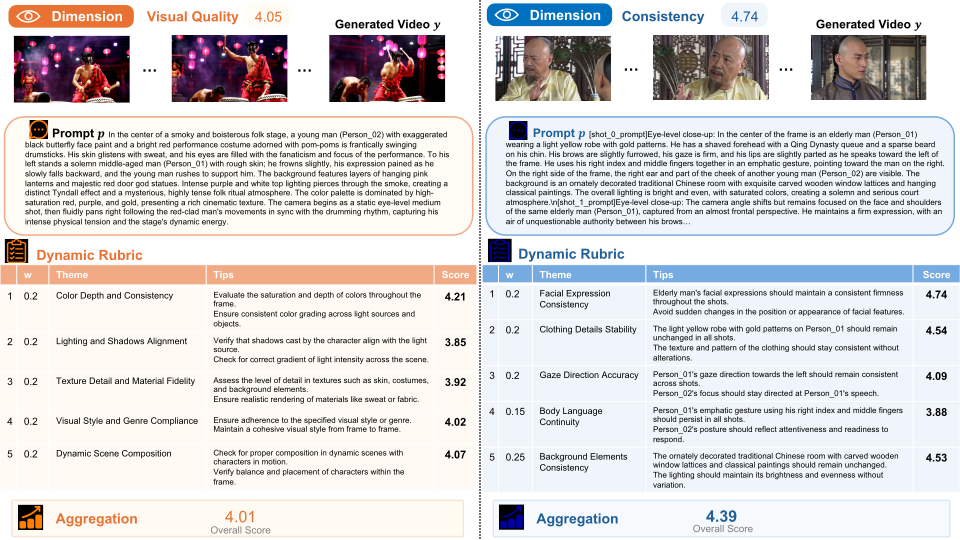
The generator adapts the granularity of its tips to the target dimension: abstract for global, technical or aesthetic axes, and grounded in the specific entities of the prompt for identity- or scene-bound axes.

Qualitative examples of dynamic rubrics generated by RewardVerse
Left (Visual Quality): themes and tips stay abstract. Right (Consistency): tips bind to concrete entities in the prompt β€” e.g. tracking β€œthe light yellow robe with gold patterns on Person_01” β€” because exactly those elements must stay stable.
Citation

BibTeX

If you find this work useful, please cite it. Code, rubrics, data splits and trained reward models will be released upon acceptance.

@misc{tang2026rewardverserubricguidedpolicyoptimization,
      title={RewardVerse: Rubric-Guided Policy Optimization for Video Reward Modeling}, 
      author={Zhenchen Tang and Yang Li and Songlin Yang and Bo Peng and Xiaotong Zhao and Shuai Li and Haotian Fan and Alan Zhao and Jing Dong},
      year={2026},
      eprint={2609.22947},
      archivePrefix={arXiv},
      primaryClass={cs.CV},
      url={https://arxiv.org/abs/2609.22947}, 
}

Repository

github.com/2kxx/RewardVerse
Watch / star for the release.

Paper

Download the PDF
25 pages incl. appendix.